

The Formation of a Minimalist Vision
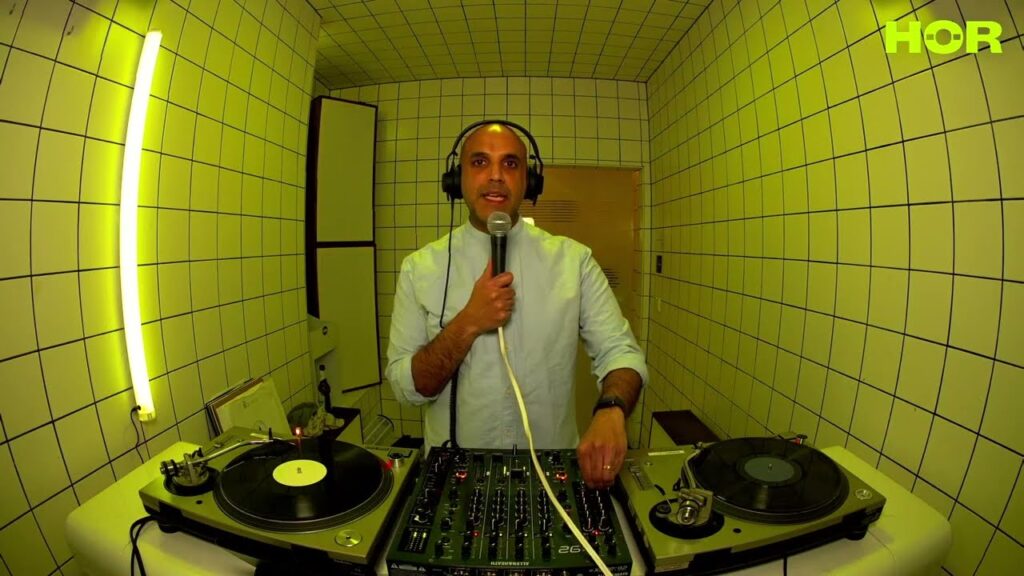
In the pulsating, often neon-saturated world of electronic dance music, subtlety can be a radical act. Amotik—born Anil Chawla on May 30, 1980, in the United Kingdom—has built a formidable international reputation not through spectacle, but through restraint. A British-Indian producer and DJ now firmly rooted in Berlin, Amotik has become synonymous with hypnotic, raw, and architecturally precise techno.
His music is not defined by explosive festival “drops,” but by disciplined repetition, incremental evolution, and immersive atmosphere. In an era when electronic music often leans toward theatrical maximalism, Amotik’s “less is more” philosophy has earned him deep respect within the global techno community.
Early Rhythms: Cultural Duality and Rave-Era Foundations
Raised in an Indian-British household, Anil Chawla grew up navigating cultural duality. Traditional Indian influences coexisted with the surge of the United Kingdom’s rave explosion in the late 1980s and early 1990s. It was his older brother’s collection of rave, jungle, and acid house tape packs that first captured his imagination.
By age fifteen, Chawla was meticulously recording radio broadcasts from stations such as BBC Radio 1 and Kiss FM, absorbing DJ sets as if they were sacred texts. This era—often referred to as the UK’s “Golden Age” of rave—formed the rhythmic backbone of his sensibility.
Though he pursued formal education along conventional lines, his true schooling occurred in clubs and through obsessive listening. Before adopting the Amotik alias, he spent years in London’s house music circuit, honing technical skill and crowd intuition. That period refined his understanding of groove and pacing—skills that would later be distilled into a more minimal and austere sonic language.
Berlin: Migration and Metamorphosis
The decisive transformation occurred in 2014, when Chawla relocated to Berlin. The move was not merely geographical; it was philosophical. Berlin’s techno culture—centered around institutions like Berghain—prioritizes function, endurance, and sonic purity.
In 2015, he launched his self-titled imprint, Amotik, marking a clear departure from his earlier house-oriented projects. His approach was strikingly minimal:
- Monochromatic record sleeves
- Sparse promotional imagery
- Catalog-number EP titles (e.g., AMOTIK001, AMOTIK002)
This was an intentional erasure of ego. The focus shifted entirely to sound design and rhythmic architecture.
Sonic Philosophy: Hypnosis Over Hype
Amotik’s music operates within a disciplined $4/4$ framework, yet its power lies in micro-variation. Tracks unfold through polyrhythmic percussion, subtle tonal shifts, and carefully modulated tension. Instead of emotional peaks engineered for instant gratification, he cultivates sustained immersion.
His influences reflect a transnational dialogue:
- The raw minimalism of UK Bleep
- The industrial austerity of Berlin techno
- The soulfulness of Detroit’s pioneers
- The conceptual depth of artists like Basic Channel and Robert Hood
The result is atmospheric yet forceful—a sound equally suited to cavernous industrial spaces and intimate club basements.
Career Milestones and Discography
While many electronic producers prioritize singles, Amotik has demonstrated an ability to craft cohesive long-form works.
Debut Album: Vistār (2019)
His first full-length album, Vistār, marked a watershed moment. The title—drawn from Indian classical music terminology meaning “expansion”—signaled an embrace of his heritage within a contemporary techno framework. The album was lauded for its conceptual coherence and hypnotic flow.
Subsequent Albums
- Patanjali (2022) – A deeper exploration of cyclical rhythm and meditative intensity.
- Sthira (2025) – Widely regarded as his most mature work to date, incorporating ambient textures and increasingly complex rhythmic layering.
Selected Discography
| Year | Title | Format | Label |
|---|---|---|---|
| 2015 | AMOTIK001 | EP | Amotik |
| 2019 | Vistār | LP | Amotik |
| 2022 | Patanjali | LP | Amotik |
| 2023 | Amotik 013 | EP | AMTK+ |
| 2025 | Sthira | LP | Amotik |
Collaborations and Industry Contributions
Amotik’s reputation extends beyond his solo output. His work has appeared on Len Faki’s Figure label and on BPitch Control, founded by Ellen Allien. These affiliations signal endorsement from some of techno’s most respected curators.
He later established AMTK+, a sub-label dedicated to like-minded producers. Through it, he has acted as mentor and tastemaker, nurturing a new generation of hypnotic techno artists while preserving aesthetic discipline.
Global Stages and Performance Ethos
Amotik’s live presence has taken him to elite venues worldwide, including:
- Fabric (London)
- Contact (Tokyo)
- Berghain (Berlin)
His DJ sets emphasize patience and continuity. Rather than punctuating transitions with dramatic breakdowns, he layers textures incrementally, allowing dancers to sink into extended states of rhythmic focus.
Representation and Industry Challenges
As a British-Indian artist operating within a historically white-dominated European techno scene, Amotik’s presence carries cultural resonance. He has spoken sparingly but pointedly about representation, preferring to let excellence speak louder than rhetoric.
His commitment to anonymity and minimal branding has occasionally limited mainstream visibility, yet it has strengthened his credibility. In a social media-driven era, he has resisted personal spectacle in favor of musical integrity.
Recent Activity and Continuing Evolution (2023–2026)
As of 2026, Amotik remains a key figure in contemporary techno. Sthira has been critically praised for its atmospheric depth and compositional maturity. His recent performances demonstrate increased incorporation of ambient passages and extended, meditative build-ups.
Rather than chasing crossover appeal, he continues refining a singular aesthetic—one rooted in patience, discipline, and sonic clarity.
Legacy: Discipline as Innovation
Amotik’s legacy is not measured by mainstream awards or chart positions. Instead, it lies in his unwavering defense of hypnotic techno’s core principles:
- Repetition as transcendence
- Minimalism as strength
- Cultural synthesis without dilution
- Independence as artistic power
He stands as a bridge between the UK rave generation and Berlin’s industrial minimalism—an artist who transformed personal heritage into sonic architecture.


