

The Enigmatic Architect of Detroit’s Soulful Electronic Sound
Early Life and Musical Heritage
Full Birth Name: Kenny Dixon Jr.
Born: 1967
Birthplace: Detroit, Michigan, United States
Kenny Dixon Jr. was born into one of America’s most musically fertile cities. Detroit had already produced a legacy of transformative musical movements—from Motown soul to the pioneering electronic experiments of Detroit techno.
Dixon grew up surrounded by music. His family had deep roots in Detroit’s soul and jazz scenes; notably, his father was connected with musicians associated with the Motown ecosystem. The sounds of artists such as Marvin Gaye, Stevie Wonder, and The Temptations filled his childhood environment.
Equally formative were the sounds of jazz legends like Miles Davis and John Coltrane, alongside funk innovators such as George Clinton. These influences would later become the emotional backbone of Moodymann’s productions.
While details of his formal education remain largely private—consistent with Dixon’s lifelong resistance to publicity—his musical education occurred through immersion in Detroit’s vibrant record culture, DJ community, and underground club scene.
Detroit in Transition: The Cultural Environment That Shaped Him
During the 1970s and 1980s, Detroit faced economic decline following the contraction of the automobile industry. Yet in the city’s clubs and basements, a new electronic sound was emerging.
Artists such as Juan Atkins, Derrick May, and Kevin Saunderson—often referred to as the Belleville Three—were pioneering Detroit techno.
Simultaneously, Chicago DJs like Frankie Knuckles were shaping house music. Dixon absorbed both movements, but rather than imitate them, he fused their electronic pulse with Detroit’s soulful legacy.
The Birth of Moodymann
In the early 1990s, Kenny Dixon Jr. began releasing music under the alias Moodymann. The name captured his aesthetic: introspective, emotional, and unpredictable.
Unlike many producers who pursued polished studio production, Moodymann embraced raw textures, vinyl crackle, and live instrumentation. His music frequently incorporated samples from classic soul records and snippets of everyday conversation—creating tracks that felt intimate, almost documentary in tone.
In 1994 he founded the influential independent label KDJ Records, which became the primary outlet for his music. The label’s philosophy reflected Dixon’s deep belief in artistic autonomy: limited pressings, vinyl-first releases, and minimal marketing.
Breakthrough Releases and Artistic Identity
Moodymann’s early EPs quickly circulated among underground DJs. Tracks like “The Day We Lost the Soul” and “I Can’t Kick This Feeling When It Hits” demonstrated his unique blend of deep house grooves and emotionally charged sampling.
His debut album, Silentintroduction (1997), established him as one of electronic music’s most distinctive voices. The album fused:
- Soulful vocals
- Warm analog basslines
- Jazz-inflected chord progressions
- Spoken-word reflections on love, race, and nightlife
Unlike conventional dance albums, the record felt deeply autobiographical.
A Unique Sonic Philosophy
Moodymann’s production approach defies many EDM conventions.
While mainstream electronic music often prioritizes high-energy festival drops, Moodymann’s tracks emphasize:
- Groove over spectacle
- Soul over precision
- Atmosphere over structure
His work blends deep house, Detroit techno, jazz improvisation, and vintage funk aesthetics.
Many tracks incorporate live instrumentation—including bass, Fender Rhodes, and percussion—recorded in Dixon’s Detroit studio.
Key Albums and Career Milestones
Throughout the late 1990s and 2000s, Moodymann released a series of albums that solidified his reputation as an underground icon.
Major Albums
| Year | Album | Significance |
|---|---|---|
| 1997 | Silentintroduction | Established Moodymann’s soulful house aesthetic |
| 2000 | Forevernevermore | Widely regarded as a deep house masterpiece |
| 2004 | Black Mahogani | Expanded jazz and funk influences |
| 2010 | Picture This | Marked his return after a quieter period |
| 2014 | Moodymann | Self-titled album with introspective themes |
| 2020 | Taken Away | A modern reflection on Detroit life and culture |
Tracks such as “Shades of Jae,” “Lyk U Use 2,” and “Freeki Mutha Fker”** became staples among underground DJs worldwide.
Collaborations and Influence
Though known for working independently, Moodymann has collaborated with numerous artists across genres.
Notable collaborators and admirers include:
- Theo Parrish
- Andrés (DJ)
- Carl Craig
- Flying Lotus
He also influenced generations of producers working within deep house and soulful techno scenes.
Performing Persona and DJ Culture
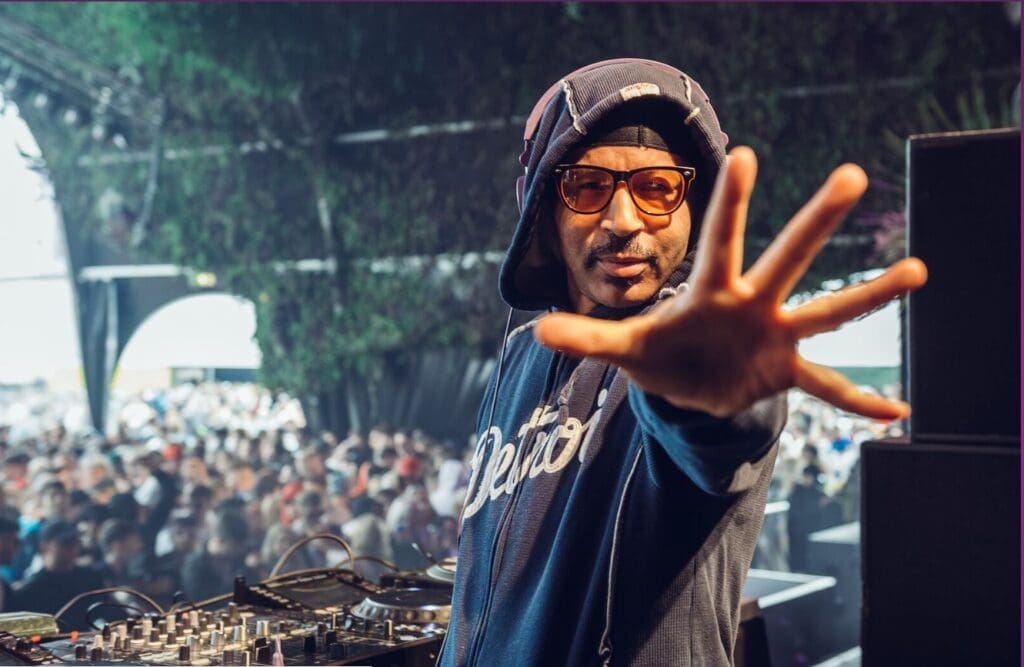
Moodymann’s DJ performances are legendary. Often performing in dim lighting or with his face partially hidden, he deliberately rejects celebrity culture.
His sets are deeply narrative, blending:
- Classic soul records
- Detroit techno
- Jazz
- Unreleased edits
In Detroit, he became closely associated with the historic Movement Electronic Music Festival, where his performances regularly attract devoted crowds.
Personal Philosophy and Cultural Commentary
Moodymann’s music frequently addresses themes rarely discussed in electronic dance music:
- Black identity in electronic music
- Detroit’s economic struggles
- Relationships and intimacy
- Cultural authenticity
In interviews, he has often argued that house and techno are Black musical forms whose roots should never be forgotten.
His records sometimes include spoken reflections on social realities in Detroit, making his work as much social commentary as dance music.
Challenges and Controversies
Moodymann’s fiercely independent personality has occasionally led to tension within the music industry.
Notable challenges include:
Resistance to commercialization:
Dixon has repeatedly criticized large EDM festivals and the commercialization of house music.
Legal and public incidents:
Over the years, he has faced occasional legal issues and public disputes—often tied to his outspoken personality and unconventional lifestyle.
Despite these controversies, many fans see his rebellious stance as central to his authenticity.
Public Personal Life
Kenny Dixon Jr. is famously private. Unlike many DJs, he rarely discusses his personal relationships or family life publicly.
However, he is known for remaining deeply connected to Detroit’s community. Beyond music, he has also operated local businesses—including a soul food restaurant and car wash—reflecting his commitment to the city that shaped him.
Recent Activities and Modern Recognition
In recent years Moodymann has experienced a resurgence in popularity among younger audiences.
His music has appeared in video games such as Grand Theft Auto Online, introducing his sound to a global gaming audience.
He continues to release music through KDJ Records and perform internationally while maintaining Detroit as his creative base.
Awards and Recognition
Although Moodymann rarely participates in mainstream award circuits, he has received widespread critical acclaim.
| Year | Recognition | Organization |
|---|---|---|
| Various | Top DJ rankings | Resident Advisor |
| Various | Underground House Icon | Electronic music press |
| 2020s | Lifetime influence recognition | Detroit music institutions |
His most meaningful accolades come from fellow artists and DJs who view him as a guardian of Detroit’s musical legacy.
Selected Discography
Studio Albums
- Silentintroduction (1997)
- Forevernevermore (2000)
- Black Mahogani (2004)
- Picture This (2010)
- Moodymann (2014)
- Taken Away (2020)
Notable Singles & EPs
- “Shades of Jae”
- “I Can’t Kick This Feeling When It Hits”
- “Lyk U Use 2”
- “Freeki Mutha F**ker”
Legacy: A Guardian of Soul in Electronic Music
Moodymann’s legacy lies not in chart dominance or festival headlining slots, but in artistic integrity.
He represents a philosophy that electronic music can remain:
- deeply personal
- culturally rooted
- spiritually expressive
In an era where EDM often emphasizes spectacle, Moodymann’s work reminds listeners that dance music began in intimate clubs, among marginalized communities seeking connection and liberation.


