

A Portrait of Modern Techno’s Relentless Architect
Early Life and Formative Years
Born Amelie Lens on 31 May 1990 in Vilvoorde, a municipality on the outskirts of Brussels, Amelie Lens emerged from modest beginnings to become one of the most commanding figures in contemporary electronic music. Raised primarily by her mother after her parents separated during her childhood, Lens grew up in a close-knit household that fostered independence, resilience, and introspection—qualities that would later define both her music and public persona.
As a teenager, Lens gravitated toward fashion and nightlife culture rather than formal musical training. She briefly pursued modeling, working internationally in cities such as Milan and Paris. While modeling offered exposure to cosmopolitan environments, it also sharpened her awareness of the transient, often superficial nature of image-driven industries. This early experience would later inform her insistence on artistic authenticity over celebrity spectacle.
Her formal education did not initially center on music; rather, her musical literacy developed through immersion. Belgium’s rich electronic heritage—stretching from the new beat movement of the late 1980s to its globally revered techno festivals—became her informal conservatory. By her late teens, Lens had begun exploring DJing with her then-partner, experimenting with vinyl records and absorbing the mechanics of mixing through practice rather than institutional instruction.
Belgium’s Electronic Heritage and Early Influences
Belgium occupies a singular place in electronic music history, and Lens’s rise cannot be separated from that context. Festivals such as Tomorrowland and institutions like Dour Festival formed part of her early exposure to large-scale dance culture. Yet it was not the mainstream EDM boom that captured her imagination—it was techno’s hypnotic minimalism and physical intensity.
Lens has often cited the transformative impact of hearing artists like Richie Hawtin and Adam Beyer in club settings. Their stripped-down, relentless soundscapes demonstrated that repetition could be transcendental rather than monotonous. She was equally drawn to the darker, industrial textures of European underground techno, which would later become a hallmark of her own productions.
Her aesthetic sensibility was shaped by Berlin’s club culture—particularly the uncompromising ethos associated with institutions such as Berghain. Though Belgian by birth, Lens’s musical identity is pan-European: a fusion of Belgian new beat grit, Germanic industrial pulse, and contemporary peak-time energy.
First Steps Behind the Decks
Lens began DJing in earnest in the early 2010s, initially performing in smaller Belgian clubs. Her breakthrough came after she won a DJ contest that led to her first significant festival booking. Soon thereafter, she launched her own label, LENSKE, in 2014. The label was conceived not merely as a distribution channel but as a curatorial platform—an extension of her sonic philosophy emphasizing driving percussion, sharp hi-hats, and emotive yet austere melodies.
Her early EPs, including “Exhale” and “Let It Go,” quickly gained traction in techno circles. Rather than chasing commercial crossover, Lens doubled down on a sound that was intense, disciplined, and rhythmically uncompromising. This clarity of vision distinguished her from many contemporaries navigating the blurred boundaries between EDM spectacle and underground credibility.
Global Ascent and Festival Dominance
By the late 2010s, Amelie Lens had become a fixture on the global techno circuit. Her performances at Awakenings Festival in the Netherlands signaled her acceptance into the upper echelon of European techno. Appearances at Time Warp and repeat bookings at Tomorrowland further consolidated her international stature.
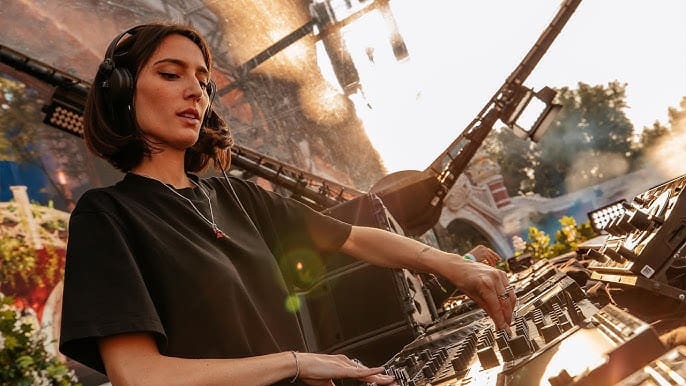
Her DJ sets are known for their narrative architecture. Unlike many festival DJs who rely on abrupt drops and dramatic genre shifts, Lens crafts gradual ascents—layering percussion, modulating tension, and sustaining momentum across extended passages. For newcomers to EDM, her sets offer a masterclass in techno’s core principle: the dance floor as a site of collective hypnosis.
In 2018, she launched EXHALE, an event series and community platform that expanded her influence beyond DJing. EXHALE evolved into a global brand, hosting label showcases and curated nights across Europe and beyond. The initiative positioned Lens not merely as a performer but as an architect of culture—providing space for emerging techno talent and fostering inclusivity within a historically male-dominated genre.
Production Style and Musical Characteristics
Lens’s production style is defined by:
- Fast BPM ranges (typically 130–140 BPM)
- Crisp, metallic percussion
- Driving basslines
- Subtle melodic motifs
- A disciplined avoidance of excessive ornamentation
Her tracks often emphasize physicality over sentimentality, yet beneath the industrial exterior lies a profound sense of emotional release. This duality—severity and catharsis—has become her artistic signature.
She has collaborated and shared stages with prominent figures such as Charlotte de Witte, contributing to Belgium’s remarkable prominence in global techno. Her releases through labels including Drumcode further embedded her within the international techno infrastructure.
Challenges and Gender Dynamics
Techno’s upper ranks have historically been male-dominated, and Lens’s rapid ascent was not without scrutiny. Early in her career, some critics questioned whether her modeling background overshadowed her musical credibility. Rather than directly engaging in public disputes, she responded through consistency—delivering technically precise, high-intensity performances that silenced skeptics.
Lens has spoken candidly about the pressures of touring and the mental strain of constant travel. The COVID-19 pandemic temporarily halted live events, yet it also allowed her to recalibrate creatively. During this period, she focused on studio production and digital community-building through EXHALE.
Public Persona and Personal Life
Amelie Lens maintains a relatively private personal life, though aspects have intersected with her public narrative. She was previously in a long-term relationship with a fellow DJ and collaborator, an experience that influenced her early musical exploration. In later interviews, she has reflected on the importance of independence and self-definition.
Lens has occasionally discussed her interest in mindfulness and introspection—qualities that inform her disciplined work ethic. Her image—minimalist, monochrome, and understated—mirrors her sonic identity. Rather than theatrical flamboyance, she embodies focus.
Awards and Recognition
While techno operates largely outside mainstream award structures, Lens has garnered widespread industry acclaim.
| Year | Recognition | Organization |
|---|---|---|
| Multiple Years | Top 100 DJs Rankings | DJ Mag |
| Industry Honors | Best Techno DJ nominations | Various Electronic Music Platforms |
| Festival Headliner Status | Major Global Festivals | International Promoters |
Her most significant accolade may be her consistent headlining status at the world’s most respected techno festivals—a recognition earned through peer respect and audience loyalty rather than commercial metrics.
Selected Discography
EPs & Notable Releases:
- Exhale (2016)
- Contradiction
- Basiel
- Various releases on LENSKE and Drumcode
Labels Founded:
- LENSKE (2014– )
- EXHALE (Event & Label Expansion)
Contribution to the Broader Entertainment Landscape
Amelie Lens’s contribution transcends track production. She has:
- Helped reposition techno within mainstream festival lineups without diluting its core aesthetics.
- Amplified female representation in high-intensity techno.
- Built scalable platforms (LENSKE and EXHALE) nurturing emerging artists.
- Demonstrated that underground credibility and global reach are not mutually exclusive.
Her disciplined approach contrasts with the maximalist tendencies of mainstream EDM, thereby educating broader audiences about techno’s subtler power.


