

A Pioneer of Unfiltered Dancefloor Energy
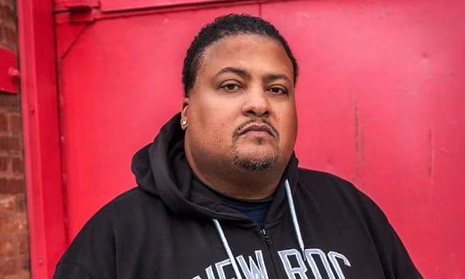
Early Life and Background
Full Birth Name: Deeon Boyd
Date of Birth: April 5, 1968
Place of Birth: Chicago
Deeon Boyd was born and raised on the South Side of Chicago, a city widely regarded as the birthplace of house music.
Growing up in a predominantly African American community, Boyd was immersed in a vibrant cultural environment shaped by music, street culture, and resilience.
While detailed information about his family life and formal education remains limited, his upbringing in Chicago’s urban landscape played a decisive role in shaping his artistic voice. The city’s legacy of DJs, warehouse parties, and community-driven music scenes provided both inspiration and opportunity.
Musical Beginnings: From House to Ghetto House
DJ Deeon’s entry into music began in the late 1980s and early 1990s, during a period when house music was evolving into various regional styles. Influenced by pioneers such as:
- Frankie Knuckles
- DJ Funk
- Lil Louis
Boyd began experimenting with production techniques that stripped house music down to its bare essentials: drum machines, repetitive loops, and commanding vocal hooks.
This minimalist approach would soon crystallize into what became known as ghetto house—a fast-paced, bass-heavy subgenre characterized by explicit lyrics, looped samples, and relentless rhythms designed for dancefloor impact.
Rise to Prominence: Dance Mania and the Chicago Scene
DJ Deeon’s breakthrough came through his association with Dance Mania, a seminal label that became synonymous with ghetto house and juke music.
During the 1990s, Deeon released a series of influential tracks that would define the genre, including:
- “Freak Like Me”
- “House-O-Matic”
- “Work This Mutha Fucker”
These records, often distributed on vinyl and played in local clubs and radio mixes, gained cult status within Chicago and beyond. Their raw energy and unapologetic lyrical content resonated with audiences seeking music that reflected their lived experiences.
Artistic Style: Minimalism, Repetition, and Provocation
DJ Deeon’s sound is unmistakable. His productions are built on:
- Rapid-fire drum patterns
- Loop-based structures
- Call-and-response vocal samples
- Bold, often explicit lyrical themes
Unlike more melodic or progressive forms of EDM, his music prioritizes rhythm and immediacy. Tracks are designed not for passive listening but for physical response—movement, sweat, and collective energy on the dancefloor.
For newcomers, his style may seem stark or confrontational, yet it is precisely this directness that defines its cultural authenticity.
Global Recognition and Second Wave Success
Although DJ Deeon’s initial impact was largely localized, the 2010s brought a renewed global interest in Chicago’s underground sounds. European labels and DJs began rediscovering ghetto house, leading to a resurgence in Deeon’s career.
He collaborated with and influenced a new generation of artists, including:
- DJ Rashad
- DJ Spinn
- Addison Groove
His performances at international festivals and clubs introduced global audiences to the raw intensity of Chicago’s dance culture.
Discography Overview
Selected Releases
| Year | Project/Track | Notes |
|---|---|---|
| 1994 | Freak Like Me | Defining ghetto house anthem |
| 1995 | House-O-Matic | Club staple |
| 1996 | Work This Mutha Fucker | Genre-defining track |
| 2010s | Various reissues & new releases | Global resurgence |
Awards and Recognition
| Category | Achievement |
|---|---|
| Cultural Influence | Pioneer of ghetto house genre |
| Industry Legacy | Key figure in Chicago house movement |
| Global Impact | Influenced footwork and bass music scenes |
While mainstream awards eluded him, DJ Deeon’s influence is deeply embedded in the DNA of modern electronic music.
Challenges and Controversies
DJ Deeon’s career was not without controversy. His music often featured explicit sexual content, which:
- Limited radio play and mainstream acceptance
- Sparked debates حول censorship and artistic freedom
- Positioned him as both a provocateur and cultural commentator
Additionally, like many underground artists, he navigated financial and structural challenges within an industry that often overlooked grassroots innovators.
Personal Life and Cultural Identity
DJ Deeon maintained a relatively private personal life, choosing to focus public attention on his music and performances. However, his work reflects key aspects of his identity:
- A deep connection to Chicago’s South Side culture
- An unfiltered expression of urban life
- A commitment to authenticity over commercial appeal
His music can be understood as both entertainment and social document—capturing the language, humor, and realities of his community.
Final Years and Passing
DJ Deeon continued to perform and produce music into the 2010s, enjoying renewed recognition from global audiences.
He passed away on July 25, 2020, leaving behind a legacy that continues to resonate across dance music communities worldwide.
Legacy: The Blueprint of Ghetto House
The legacy of DJ Deeon is profound and far-reaching. His contributions include:
- Establishing the sonic framework of ghetto house
- Influencing the evolution of footwork and juke music
- Inspiring producers across genres—from techno to bass music
Today, elements of his style can be heard in clubs from Chicago to London, Berlin to Lagos.
DJ Deeon’s music challenges listeners to reconsider what electronic music can be. Stripped of ornamentation and driven by raw energy, his work stands as a testament to the power of simplicity and authenticity.


